

Shoe Size Conversion
Pick any value below and the others update instantly.
Buying shoes online can be a gamble when you do not know your exact size across different countries. Every brand fits a bit differently. Figuring out how a US size translates to an EU, UK, or Asian size is often a frustrating process.
If you are tired of dealing with returns because your new sneakers pinch your toes or slip off your heels, you are in the right place. Below, we break down everything you need to know about finding your true shoe size. We included detailed charts for every age group and simple rules for converting sizes globally.
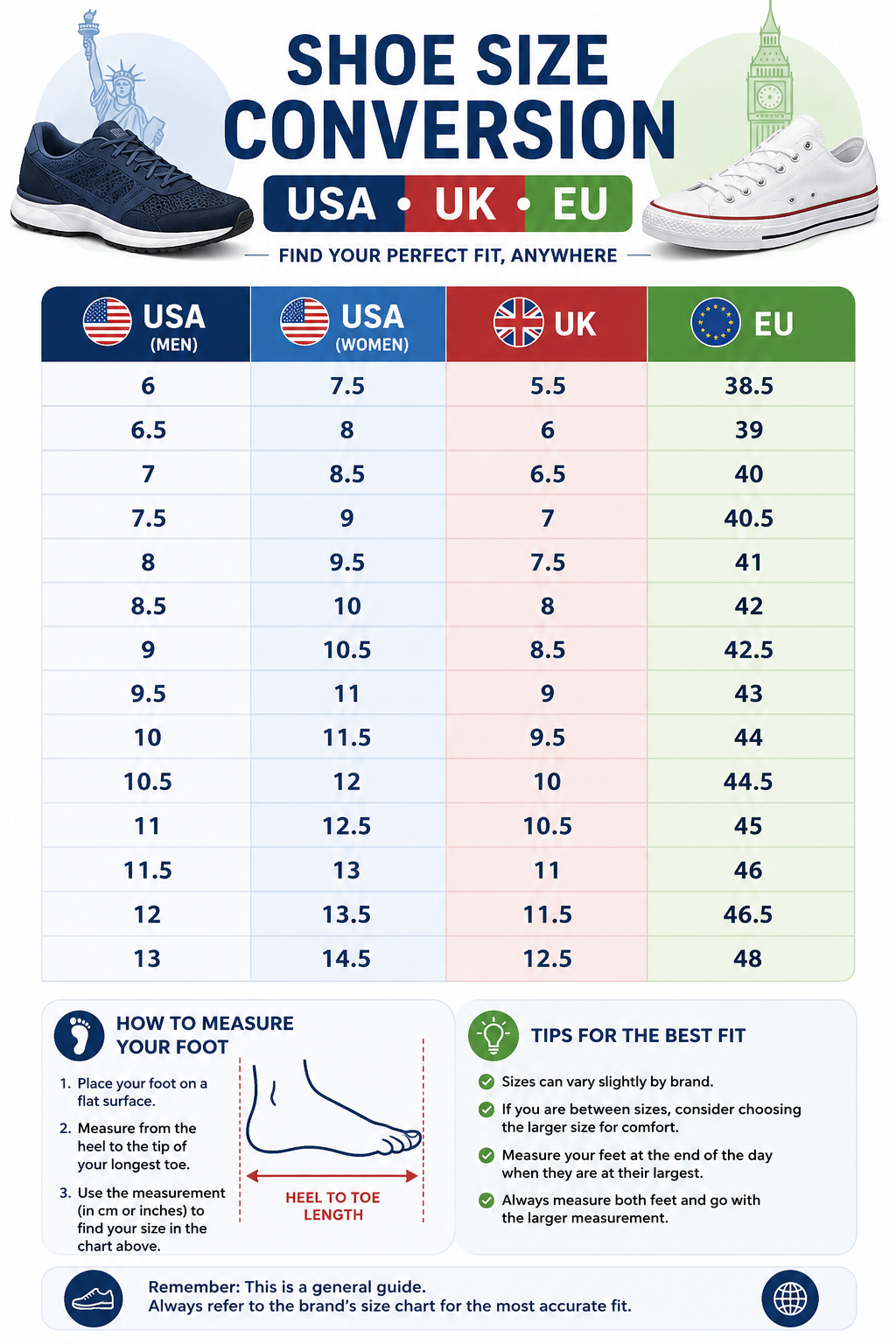
Comprehensive Shoe Size Conversion Charts
Use these reference charts to see how standard sizes compare across the globe. These tables include conversions for US/CA, UK/India, Europe (EU), Japan/Mexico (JP/MX), China (CN), and exact foot lengths.
Women's Shoe Size Chart
| US/CA | UK/IN | EU | JP/MX | CN | Inches | CM |
|---|---|---|---|---|---|---|
| 4 | 2 | 34 | 21 | 32 | 8.3" | 21.2 |
| 4.5 | 2.5 | 34.5 | 21.5 | 33 | 8.5" | 21.6 |
| 5 | 3 | 35 | 22 | 34 | 8.7" | 22.0 |
| 5.5 | 3.5 | 36 | 22.5 | 35 | 8.8" | 22.4 |
| 6 | 4 | 36.5 | 23 | 36 | 9.0" | 22.9 |
| 6.5 | 4.5 | 37 | 23.5 | 37 | 9.2" | 23.3 |
| 7 | 5 | 38 | 24 | 38 | 9.3" | 23.7 |
| 7.5 | 5.5 | 38.5 | 24.5 | 39 | 9.5" | 24.1 |
| 8 | 6 | 39 | 25 | 39.5 | 9.7" | 24.6 |
| 8.5 | 6.5 | 40 | 25.5 | 40 | 9.8" | 25.0 |
| 9 | 7 | 40.5 | 26 | 41 | 10.0" | 25.4 |
| 9.5 | 7.5 | 41 | 26.5 | 42 | 10.2" | 25.8 |
| 10 | 8 | 42 | 27 | 42.5 | 10.3" | 26.2 |
| 11 | 9 | 43 | 28 | 44 | 10.7" | 27.1 |
| 12 | 10 | 44 | 29 | 46 | 11.0" | 27.9 |
Men's Shoe Size Chart
| US/CA | UK/IN | EU | JP/MX | CN | Inches | CM |
|---|---|---|---|---|---|---|
| 6 | 5 | 38 | 23.5 | 37 | 9.3" | 23.7 |
| 6.5 | 5.5 | 38.5 | 24 | 38 | 9.5" | 24.1 |
| 7 | 6 | 39 | 24.5 | 39 | 9.7" | 24.6 |
| 7.5 | 6.5 | 40 | 25 | 40 | 9.8" | 25.0 |
| 8 | 7 | 40.5 | 25.5 | 41 | 10.0" | 25.4 |
| 8.5 | 7.5 | 41 | 26 | 42 | 10.2" | 25.8 |
| 9 | 8 | 42 | 26.5 | 43 | 10.3" | 26.2 |
| 9.5 | 8.5 | 42.5 | 27 | 44 | 10.5" | 26.7 |
| 10 | 9 | 43 | 27.5 | 45 | 10.7" | 27.1 |
| 10.5 | 9.5 | 44 | 28 | 46 | 10.8" | 27.5 |
| 11 | 10 | 44.5 | 28.5 | 47 | 11.0" | 27.9 |
| 12 | 11 | 46 | 29.5 | 49 | 11.3" | 28.8 |
| 13 | 12 | 47 | 30.5 | 51 | 11.7" | 29.6 |
| 14 | 13 | 48 | 31.5 | 52 | 12.0" | 30.5 |
Kid's Shoes (Ages 5 - 12)
| US/CA | UK/IN | EU | JP/MX | CN | Inches | CM |
|---|---|---|---|---|---|---|
| 10.5 | 9.5 | 28 | 17 | 24 | 6.8" | 17.1 |
| 11 | 10 | 28.5 | 17.5 | 25 | 7.0" | 17.8 |
| 12 | 11 | 30 | 18 | 26 | 7.2" | 18.4 |
| 13 | 12 | 31 | 19 | 27 | 7.5" | 19.1 |
| 1 | 13 | 32 | 20 | 28 | 7.9" | 20.0 |
| 2 | 1 | 33 | 21 | 29 | 8.2" | 20.8 |
| 3 | 2 | 34 | 22 | 30 | 8.5" | 21.6 |
Infant & Toddler Shoes (Ages 0 - 4)
| US/CA | UK/IN | EU | JP/MX | CN | Inches | CM |
|---|---|---|---|---|---|---|
| 2 | 1 | 17 | 10 | 10 | 3.9" | 9.9 |
| 3 | 2 | 18 | 11 | 11 | 4.1" | 10.5 |
| 4 | 3 | 19 | 11.5 | 12 | 4.5" | 11.4 |
| 5 | 4 | 20 | 12 | 13 | 4.8" | 12.1 |
| 6 | 5 | 22 | 13 | 14 | 5.1" | 13.0 |
| 7 | 6 | 23 | 14 | 15 | 5.5" | 14.0 |
How to Convert Shoe Sizes (The Quick Rules)
Memorizing the conversion charts is not necessary if you know the basic rules of thumb. Here is how you can quickly do the math in your head when shopping for international brands.
How to Convert Men's Shoe Sizes
- US to UK: The general rule for men is to subtract 1 size. If you are a US Men's 10, you will typically wear a UK 9. (Note: Some athletic brands like Nike or Adidas occasionally use a half size offset, but a full size is the global standard).
- US to EU: This requires a bit more math. A US Men's 9 is typically an EU 42. For every full US size you go up, you add roughly 1 to 1.5 to the EU size.
- US to CM/Japan: Japanese sizing (JP) is very simple. It is just the length of your foot in centimeters. If your foot is 27 cm long, your Japanese size is 27.
How to Convert Women's Shoe Sizes
- US to UK: The main rule for women is to subtract 2 sizes. If you wear a US Women's 8, you will look for a UK 6. It is that simple.
- US to EU: A US Women's 7 is generally an EU 38. Just like men's sizes, EU sizes do not perfectly align with US half-sizes, so you may find yourself sizing up to the nearest whole European number if you have a wider foot.
- Women's vs. Men's US Sizes: If you are a woman buying a unisex or men's shoe (like Vans or Converse), subtract 1.5 sizes from your normal women's size. A Women's 9 equals a Men's 7.5.
How to Convert Kids' & Infants' Shoe Sizes
Children's shoe sizing is often confusing because the US system resets itself. It starts at Infant sizes (1-13), then rolls back to Youth sizes (1-7) before entering adult sizing.
- UK Conversions: For kids, the UK size is almost always exactly one size smaller than the US size. A US Toddler 5 is a UK Toddler 4.
- The EU Advantage: This is where the European system shines. EU kids' sizing does not reset. It just counts up continuously from 17 (tiny baby) to 38 (pre-teen). If you want to avoid sizing issues when buying kids shoes, measure their feet in centimeters and convert directly to EU sizing.
How To Measure Your Shoe Size at Home
Do not rely on the size of the worn-out sneakers currently in your closet. Feet can change size over time due to age, weight fluctuations, or even the time of day (feet tend to swell in the afternoons). Here is the best way to measure your feet right now:
- Step 1: Grab your supplies. You need a piece of paper larger than your foot, a pen, and a ruler or measuring tape.
- Step 2: Tape the paper to the floor. This stops it from sliding around. Make sure you are wearing the type of socks you plan to wear with the shoes you want to buy (like thick wool socks for winter boots).
- Step 3: Trace your foot. Stand up straight and plant your foot firmly on the paper. Keep your weight centered. Trace the outline of your foot, keeping the pen perfectly straight (perpendicular to the floor) so you do not accidentally trace underneath your heel.
- Step 4: Measure the length. Use your ruler to measure the straight line from the very back of your heel to the tip of your longest toe. Write this down in both inches and centimeters.
- Step 5: Measure the other foot. Almost everyone has one foot that is slightly larger than the other. Always buy shoes that fit the larger foot.
What is the Difference Between US, UK, and EU Shoe Sizes?
Shoe sizing is confusing because there is no universal global standard. Different parts of the world developed their own measuring systems centuries ago, and we still use them today.
USA Sizing Explained
The US shoe sizing system is historically based on the length of a barleycorn (which is exactly one-third of an inch). It is a bit quirky because it does not start at zero. The biggest thing to remember with US sizing is that men's and women's sizes are not the same scale. As mentioned above, a US women's size is typically 1.5 sizes larger than a men's size.
UK Sizing Explained
UK sizing was standardized by King Edward II and, just like the US, it is based on the barleycorn measurement. However, the UK system is much more straightforward when it comes to gender. In the UK, a shoe size is a shoe size, regardless of whether it is for a man or a woman. If a shoe has a sole of a certain length, it gets a specific number.
EU (European) Sizing Explained
The European shoe sizing system is very practical. It ditches the medieval barleycorns and uses a measurement called the "Paris Point," which is exactly two-thirds of a centimeter. Like the UK system, EU sizing is completely unisex. There is no difference between a men's 42 and a women's 42. They are the exact same length.