

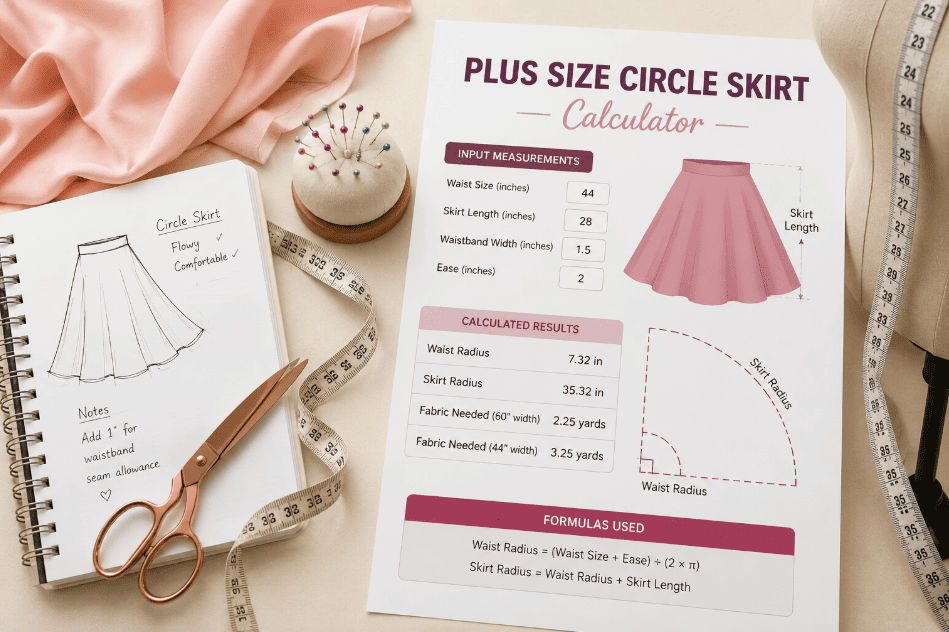
If you've ever felt overwhelmed by the math required to draft a circle skirt, you're in the right place. Creating a custom-fit skirt should be a fun and creative process, not a frustrating math test.
Whether you're an experienced sewist making a formal gown or a beginner sewing your very first summer skirt, figuring out the cutting radii can be tricky. Our tool does the math for you. It automatically factors in seam and hem allowances so you can spend less time calculating and more time sewing.
Plus Size Circle Skirt Calculator Online
A common frustration with standard sewing calculators is that they don't always account for the realities of working with larger measurements. We built this plus size circle skirt calculator online to help solve the fabric limitations curvy sewists run into all the time.
Here is the reality of skirt geometry: as your waist measurement goes up, the inner waist radius goes up too. Because of this, your total hem radius (the distance from the corner of your folded fabric to the bottom hem) gets much larger. Standard fabric bolts are usually 44 to 60 inches wide. When you fold a 60-inch fabric in half to cut a seamless piece, the absolute longest skirt you can cut is 30 inches from the corner.
This calculator will warn you when your measurements exceed standard fabric widths, saving you from making a costly mistake on expensive yardage.
How This Circle Skirt Waist Calculator Works
Using our circle skirt waist calculator is quick and simple. Here is a step-by-step guide on how to use the tool to get your exact cutting measurements.
Step 1: Taking Your Measurements
Grab a flexible measuring tape. First, measure your waist exactly where you want the waistband of the skirt to sit. For a high-waisted look, measure at the narrowest part of your torso. If you prefer it to rest lower on your hips, measure there. Sewing Tip: Add 1 inch (or 2.5 cm) to your body measurement to allow for "wearing ease" so the garment isn't too tight, plus room to breathe and eat!
Next, measure your desired length. Let the tape measure fall from your chosen waistline down your leg to where you want the hem to end.
Step 2: Choosing The Right Fullness
The "fullness" dictates how much fabric sweeps around your legs. A full circle has a lot of volume, while a quarter circle is much closer to a classic A-line silhouette. Just click the visual icon that matches the drape you want to achieve.
| Skirt Fullness | Silhouette & Drape | Best Fabric Types |
|---|---|---|
| Quarter (1/4) | Subtle A-line, minimal flare. Great for everyday wear. | Heavy wools, denim, thick cotton. |
| Half (1/2) | Classic flare. The standard for vintage day dresses. | Linen, cotton lawn, medium-weight knits. |
| Three-Quarter (3/4) | Luxurious drape without the bulk of a full circle. | Rayon challis, crepe de chine. |
| Full (1) | Maximum volume, dramatic twirl factor. Poodle skirts! | Chiffon, organza, lightweight silks. |
Understanding Skirt Fullness Options
Here is a breakdown of the different skirt styles you can create with this tool. Knowing how these shapes work will make drafting your pattern much easier.
Quarter Circle Skirt Calculator (1/4 Circle)
A quarter circle skirt calculator helps you draft a skirt that uses exactly one-quarter of a geometric circle. Imagine a pizza cut into four equal slices; this pattern is just one of those slices, wrapped around your body. Because the waist circumference has to fit into a smaller arc, the waist radius for a 1/4 circle skirt calculator will be quite large compared to fuller styles. This produces a tailored A-line shape that uses the least amount of yardage. It's perfect for thick winter fabrics that would be too bulky if gathered.
Half Circle Skirt Calculator
The half circle skirt calculator is the most popular setting for modern apparel. It strikes the perfect balance—offering a beautiful, swishy hem without using yards and yards of expensive fabric. When laid flat, this pattern looks exactly like a semi-circle. It's flattering on all body types because it falls smoothly over the hips before flaring out at the hem.
3/4 Circle Skirt Calculator
Often overlooked, the 3/4 circle skirt calculator is the secret weapon of many dressmakers. Sometimes a half circle doesn't have quite enough drama, but a full circle creates too much bulk around the waist. The three-quarter option gives you gorgeous ripples of fabric (great for evening wear) without the extreme waistline bulk. To make this, you usually cut one half-circle piece for the front and two quarter-circle pieces for the back.
Double Circle Skirt Calculator
While our tool visually maps up to a full circle, you can easily use it as a double circle skirt calculator for ultimate drama, like a ballroom dancing gown. To do this, take your waist measurement, divide it by two, and type that number into the calculator while selecting the "Full Circle" option. You will then cut out TWO complete full circles using that new radius and sew them together. The hemline will be massive, and the twirl factor will be spectacular!
Creating A Circle Skirt Pattern Plus Size
Drafting your own circle skirt pattern plus size on paper before cutting your fabric is a great idea, especially if you are using slippery or expensive materials.
To draft your pattern:
- Take a large sheet of pattern paper (or tape several pieces together).
- Create a strict 90-degree angle at one corner. This is your pivot point.
- Take a piece of string and tie it to a pencil. Measure the string to match your Waist Radius (R1).
- Hold the end of the string firmly at the corner point, and draw an arc from one edge of the paper to the other.
- Lengthen the string so it matches your Hem Radius (R2) and draw a second, larger arc from the same corner point.
You've just drafted your pattern! Remember, if your hem radius is wider than your paper (or fabric), you are drafting a panel. You will need to add a seam allowance (usually 5/8") to the straight edges of your paper pattern so you can sew the panels together.
Skirts For Plus Size: Flattering Fits And Fabric Choices
When making skirts for plus size bodies, circle silhouettes are incredibly flattering. Because the fabric is cut on the bias (the diagonal of the weave), it naturally drapes and molds to the body rather than standing stiffly away from it.
Fabric choice is important here. Stiff fabrics like quilting cotton or heavy canvas will create a "tent-like" effect. For a more sophisticated, flowing skirt, choose fabrics with great drape. Rayon challis, Tencel twill, crepe, and lightweight linen blends will fall beautifully over your curves.
Mood Fabrics Circle Skirt Calculator: How We Compare
Many sewists are familiar with the mood fabrics circle skirt calculator, which is a great basic tool. However, we developed our calculator to fill in the gaps that leave many sewists frustrated.
Standard calculators often just give you the raw math. The problem with that? If you cut exactly on that line, your waist hole will be too big once you actually sew the skirt to the waistband (because you lose fabric to the seam allowance). Our tool automatically subtracts standard seam allowances from the waist radius and adds hem allowances to the length. Plus, our fabric width alert makes sure you aren't caught off guard when laying out your pattern pieces.
Important Sewing Step: Letting The Bias Hang
Before you hem your newly cut skirt, there is one essential rule: you must let it hang! Because a circle skirt is cut across the straight grain, the cross grain, and the bias (the diagonal), gravity will stretch the fabric unevenly over time.
The sections of the skirt cut on the bias will stretch out the most. If you hem the garment right away, your hemline will look wavy and uneven within a few days. Pin your skirt to a dress form or a hanger and leave it alone for at least 24 to 48 hours. Once the bias has dropped, trim the uneven bits so the hem is perfectly parallel to the floor, and then go ahead and hem it.
For finishing the hem, a narrow rolled hem foot on your sewing machine works great on lightweight fabrics. For heavier fabrics, try using bias tape facing to enclose the raw edge without adding stiffness to the sweep of the skirt.
What Other Sewists Are Saying
Here is how this tool has helped other garment makers speed up their cutting process and avoid fabric mistakes.
This calculator saved my fabric. I had no idea my plus size maxi skirt measurements would be too wide to cut on the fold. The fabric alert popped up and I realized I needed to cut panels instead. Brilliant tool!
Finally, a tool that actually accounts for seam allowances. I used to always end up with a waist hole that was an inch too big after sewing on the band. This factors it in automatically. 5 stars.
I am a beginner and math terrifies me. Being able to just click the picture of the 3/4 skirt and get my exact cutting numbers in centimeters was a lifesaver. My project came out perfectly.
Extremely well designed and easy to use on my phone while standing at the cutting table. I used the quarter circle option for a thick wool project and it drafted beautifully. Very highly recommended.
As someone who sews for a living, this is the best calculator I've found online. The fact that I don't have to manually calculate seam allowances anymore saves me so much time. It's bookmarked!